
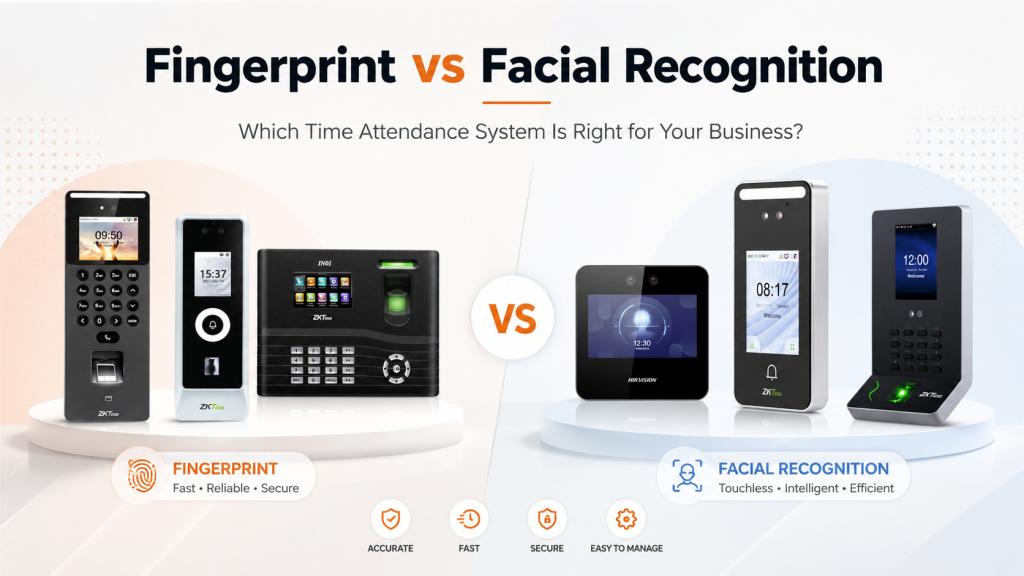
Fingerprint, Facial Recognition or Mobile Clocking: Which Time Attendance System Is Right for Your Business?
Choosing a time attendance system is not only about recording when staff arrive and leave. It is about choosing a clocking method that fits the way your business works.
An office, factory, warehouse, construction site and mobile team all have different needs. That is why some businesses work best with fingerprint clocking, while others may need facial recognition, mobile clocking or a combination of different options.
Fingerprint clocking
Fingerprint clocking is one of the most common biometric time attendance methods.
Employees clock in and out by placing their finger on a biometric reader, which verifies their identity before recording the clocking.
This is a practical option for businesses where staff work from a fixed location, such as offices, factories, warehouses, retail stores and schools.
Fingerprint clocking can also help reduce buddy clocking, as employees need to clock using their own fingerprint instead of someone else clocking in for them.
Facial recognition clocking
Facial recognition allows employees to clock in and out using their face instead of touching a device.
This is a good option for businesses that want a fast, contactless clocking method. It can also be useful in environments where fingerprints may not always be practical, such as workplaces where staff work with their hands, wear gloves or move through busy entrances.
Facial recognition works well for offices, reception areas, healthcare environments, food-related workplaces, retail and hospitality spaces.
Mobile clocking
Mobile clocking is ideal for employees who do not work from one fixed location.
This can include sales reps, technicians, cleaning teams, security staff, construction workers, maintenance teams and employees who move between different sites.
Instead of clocking in at a physical terminal, staff can clock in and out using a mobile device. This gives management better visibility over remote or mobile teams and helps reduce delays in collecting attendance information.
Which option is right for you?
The right system depends on your workplace.
Fingerprint clocking is a strong option for fixed locations. Facial recognition is ideal when you need fast, contactless clocking. Mobile clocking works best for staff who are on the road or working across different sites.
Some businesses may need more than one method. For example, office staff may use a biometric terminal, while field staff use mobile clocking.
Final thoughts
There is no single time attendance system that works for every business.
The best solution is the one that fits your staff, your working environment and your payroll process.
Biometric Time Solutions can assist with fingerprint, facial recognition and mobile clocking solutions designed around the way your business operates.
Need help choosing the right clocking system?
Speak to Biometric Time Solutions about a time attendance solution that fits your team. Contact us here


